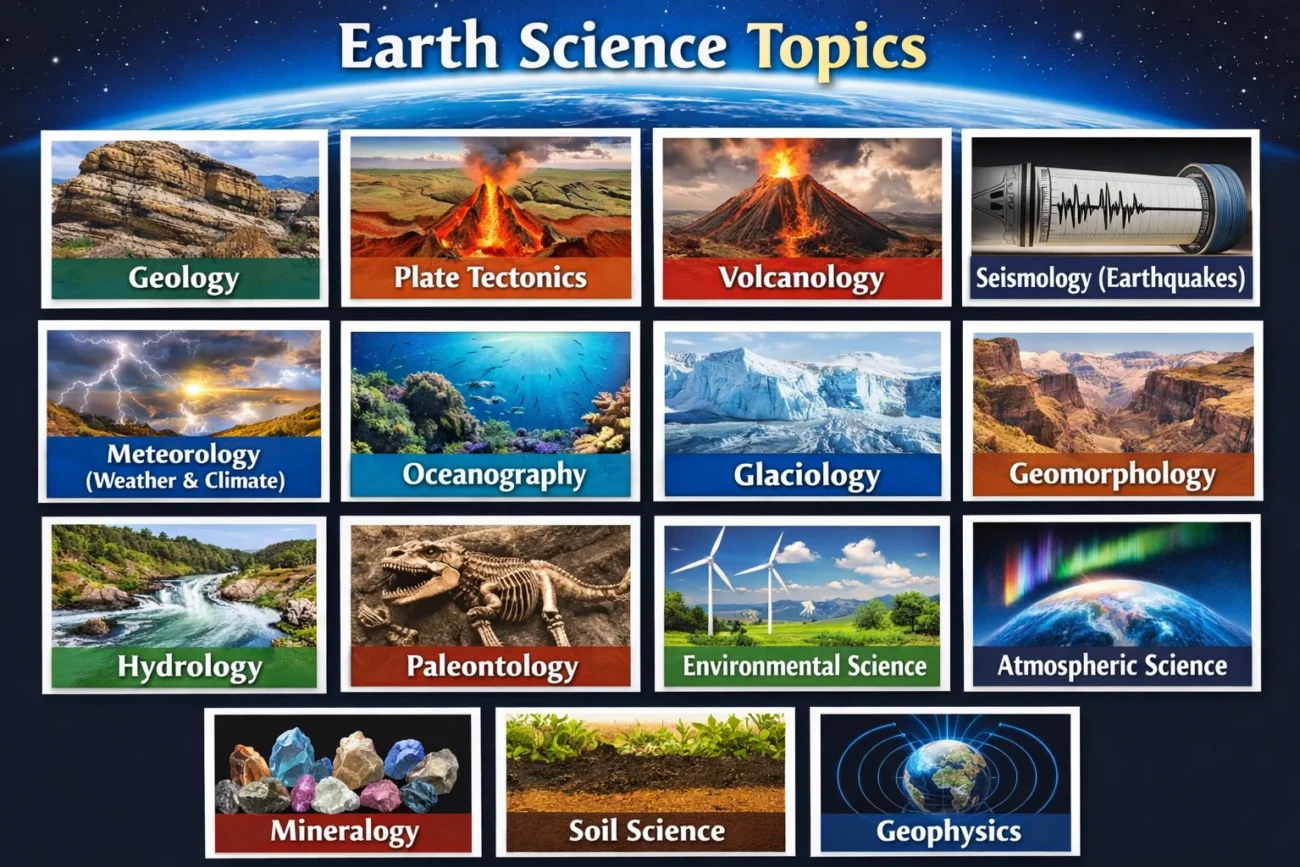
Introduction to Earth Science Topics
Earth science is a broad and dynamic field that explores the physical, chemical, and biological processes of our planet. From understanding the forces that shape mountains to studying the composition of the atmosphere, the study of earth science provides critical insights into the planet we inhabit.
The scope of earth science is vast, integrating aspects of geology, meteorology, oceanography, and environmental science. This article will explore essential earth science topics, their significance, and the role they play in modern science.
Geology and Its Core Concepts
One of the primary branches of earth science is geology, which examines the solid Earth, its materials, and the processes that act upon them. Geologists study earth science topics such as rocks, minerals, and soil composition to understand the Earth’s history. Plate tectonics, a cornerstone of geology, explains how the Earth’s lithosphere is divided into plates that move over the mantle, causing earthquakes, volcanic eruptions, and the formation of mountains.
By studying rock layers and fossil records, scientists can reconstruct past climates and biological evolution. Geology also informs practical applications, including natural resource exploration, earthquake hazard assessment, and land-use planning.
Meteorology and Weather Patterns
Meteorology, the study of the atmosphere and weather phenomena, is another critical branch of earth science. Understanding earth science topics related to meteorology is vital for predicting weather, preparing for natural disasters, and analyzing climate trends. Meteorologists examine atmospheric conditions, such as temperature, humidity, and wind patterns, to forecast weather events.
Severe weather phenomena like hurricanes, tornadoes, and blizzards are studied to mitigate risks to human life and property. Climate science, a subfield of meteorology, investigates long-term changes in temperature and precipitation, helping scientists understand global warming and its potential impact on ecosystems and societies.
Oceanography and Marine Science
The study of oceans, or oceanography, is another prominent category within earth science topics. Oceanographers examine ocean currents, marine ecosystems, and the chemical composition of seawater. Oceans play a crucial role in regulating the Earth’s climate by absorbing carbon dioxide and heat, making their study essential for understanding climate change.
Physical oceanography focuses on the movement of water, while biological oceanography investigates marine life and ecosystems. Chemical oceanography analyzes nutrients, gases, and pollutants in ocean waters. By exploring these earth science topics, scientists can develop strategies for sustainable fisheries, pollution control, and marine conservation.
Environmental Science and Human Impact
Environmental science is an interdisciplinary branch of earth science that studies the interaction between humans and the environment. It encompasses many earth science topics, including pollution, deforestation, soil degradation, and water management. Environmental scientists analyze how human activities impact ecosystems and propose solutions to mitigate negative effects.
Climate change, biodiversity loss, and air quality are key concerns within this field. By investigating environmental processes and human interventions, researchers provide data and recommendations that inform policy decisions, sustainable development, and conservation efforts worldwide.
Astronomy and Earth’s Place in Space
While astronomy may seem distant from traditional Earth science, understanding celestial phenomena is essential for comprehending Earth’s dynamics. Earth science topics intersect with astronomy when studying the Earth’s rotation, orbit, and relationship with the Sun and Moon. These studies help explain seasons, tides, and natural cycles such as solar activity and its effect on Earth’s magnetosphere.
Space-based observations provide critical data for climate monitoring, weather forecasting, and geological studies. By integrating astronomical insights, earth scientists can better predict natural events and understand Earth’s evolution over geological time scales.
Seismology and Earthquakes
Seismology, a specialized branch of geology, focuses on earthquakes and seismic waves traveling through the Earth. It is one of the most vital earth science topics for hazard assessment and disaster preparedness. Seismologists analyze patterns in earthquake activity, measure magnitudes, and study fault lines to predict future events.
Earthquake-resistant infrastructure, early warning systems, and urban planning all rely on seismological research. By studying the Earth’s internal structure through seismic waves, scientists can also infer the composition and behavior of the Earth’s core and mantle, providing valuable insights into the dynamic processes beneath the surface.
Volcanology and Volcanic Activity
Volcanology examines volcanic activity, another critical area among earth science topics. Volcanoes form when molten rock, or magma, rises from the mantle and erupts at the surface. These eruptions can have devastating consequences for nearby communities, but also create fertile soils and new landforms.
Volcanologists monitor active volcanoes using satellite imagery, gas emissions, and ground deformation to predict eruptions. Understanding volcanic processes contributes to disaster risk reduction, land-use planning, and geological research. Studying ancient volcanic deposits also helps reconstruct Earth’s geological history and informs theories on plate tectonics and crustal evolution.
Hydrology and Water Systems
Hydrology, the study of water in all its forms, is fundamental to earth science topics. Hydrologists analyze the distribution, movement, and quality of freshwater resources such as rivers, lakes, and aquifers. Water cycle studies include precipitation, evaporation, infiltration, and runoff processes.
Effective water management is crucial for agriculture, urban planning, and maintaining ecological balance. Hydrological studies also address flood prediction, drought management, and water pollution control. Understanding hydrology helps societies ensure sustainable water supplies while protecting ecosystems dependent on clean, reliable water sources.
Soil Science and Land Resources
Soil science, or pedology, investigates soil properties, formation, and fertility. It is a key subset of earth science topics because soils support agriculture, forestry, and natural ecosystems. Soil scientists study texture, structure, composition, and nutrient content to determine land suitability for various uses. Soil erosion, contamination, and degradation are significant challenges that affect food security and environmental health.
By examining soil profiles and their interactions with climate, vegetation, and human activity, researchers develop sustainable land management practices and contribute to ecological restoration efforts.
Geochemistry and Earth’s Composition
Geochemistry explores the chemical composition of Earth’s materials and processes, making it an essential area in earth science topics. It investigates the distribution of elements in rocks, minerals, water, and the atmosphere. Geochemists study natural processes such as rock weathering, mineral formation, and the cycling of elements like carbon, nitrogen, and phosphorus.
This knowledge informs fields such as mineral exploration, environmental monitoring, and pollution control. Geochemistry also plays a crucial role in understanding the Earth’s history, including the formation of continents, oceans, and the evolution of the atmosphere over billions of years.
Paleontology and Fossil Records
Paleontology, the study of fossils, provides insight into the Earth’s biological past. It is one of the most fascinating earth science topics because it connects geology with biology. Fossils help reconstruct ancient ecosystems, climate conditions, and evolutionary patterns. Paleontologists study plant and animal remains preserved in sedimentary rocks, providing a window into life millions of years ago.
Understanding past extinctions and adaptive strategies can guide conservation efforts today. By examining the fossil record, scientists also validate geological theories and uncover the complex interactions between Earth’s physical and biological systems over time.
Climatology and Global Climate Change
Climatology focuses on the study of climate systems and long-term atmospheric trends. It is a critical component of earth science topics as it addresses one of the most pressing issues of our time: climate change. Climatologists analyze historical climate data, greenhouse gas concentrations, and ocean-atmosphere interactions to model future climate scenarios.
Understanding climate patterns helps policymakers, scientists, and communities prepare for rising sea levels, extreme weather events, and shifts in ecosystems. By integrating data from meteorology, oceanography, and geochemistry, climatology provides a comprehensive view of how Earth’s climate system operates and evolves.
Geomorphology and Landform Development
Geomorphology studies the formation and evolution of landforms. It is a vital branch of earth science topics because it explains the processes shaping mountains, valleys, rivers, and coastlines. Geomorphologists investigate erosion, sedimentation, volcanic activity, and tectonic forces to understand landscape development.
This knowledge is applied in natural hazard assessment, infrastructure planning, and environmental conservation. By analyzing geomorphic processes, scientists can predict changes in landforms, assess risks of landslides or floods, and develop strategies to manage human impacts on landscapes.
Environmental Hazards and Disaster Management
The study of environmental hazards is closely linked to earth science topics. Natural disasters such as earthquakes, volcanic eruptions, floods, hurricanes, and tsunamis pose significant threats to human life and property. Earth scientists assess risk, monitor hazard-prone areas, and develop predictive models to mitigate impacts.
Disaster management integrates earth science knowledge with emergency planning, community preparedness, and public policy. By studying past events and current trends, scientists help societies anticipate hazards, respond effectively, and build resilient infrastructure to withstand natural disasters.
Renewable Energy and Earth Resources
Earth science is also crucial for understanding natural resources and renewable energy sources. Many earth science topics relate to the exploration and management of resources like solar energy, wind energy, geothermal energy, and minerals. Geologists, hydrologists, and environmental scientists collaborate to identify suitable locations for renewable energy projects, assess resource availability, and minimize environmental impacts.
Sustainable resource management ensures that energy needs are met while preserving ecosystems and reducing carbon footprints. By studying Earth’s physical and chemical processes, scientists contribute to innovations in clean energy and resource conservation.
Conclusion
The study of earth science topics encompasses a vast array of disciplines, each providing valuable insights into the Earth’s structure, processes, and interactions. From geology and meteorology to oceanography, environmental science, and climatology, these topics are interconnected, highlighting the complexity and beauty of our planet.
Understanding these areas is critical not only for scientific discovery but also for addressing global challenges such as climate change, natural disasters, and sustainable resource management. For students, researchers, and society at large, exploring earth science topics offers a pathway to knowledge, innovation, and a deeper appreciation of the Earth we call home.
