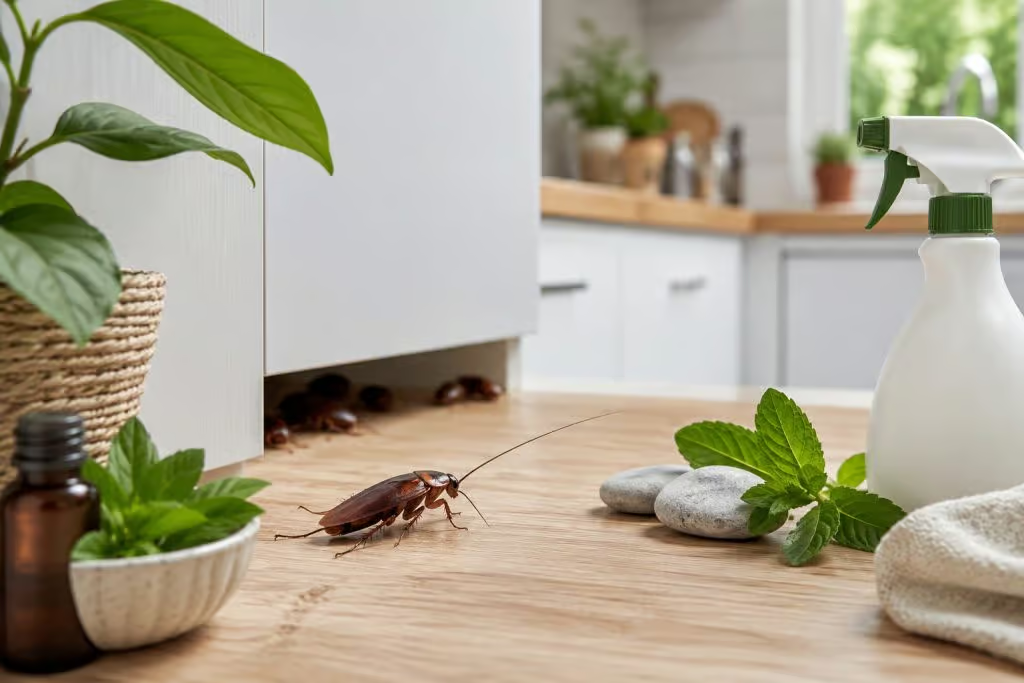
You spray. They die. You clean up, feel relieved, and move on. Then two weeks later you flick on the kitchen light at 11 pm, and there they are again, same bench, same skirting board, same sinking feeling.
Most people assume this means they used the wrong product, or didn’t use enough of it. It rarely does. Anyone who works in pest control in Surry Hills will tell you the same thing: recurring cockroaches aren’t a spraying failure they’re a diagnosis failure. You’re killing the cockroaches you can see while the actual population sits untouched behind your cabinetry.
Here’s what’s really going on.
You’re treating about 5% of the infestation
Cockroaches are thigmotactic; they like pressure on their bodies from all sides. That’s why they wedge themselves into the tightest spaces available: the motor housing behind your fridge, the gap under the dishwasher, the void behind a kickboard, the cavity where the pipework enters under the sink.
They come out to forage, briefly, in the dark. What you see on the bench at midnight is the overflow, not the population. Surface spray hits foragers. The harbourage where the bulk of them live and breed stays completely dry.
The eggs survive almost anything you spray
This is the part that actually explains the two-week pattern.
Female German cockroaches don’t lay loose eggs. They carry an ootheca, a hardened protein capsule holding 30 to 40 eggs, until it’s nearly ready to hatch. That capsule is functionally waterproof and largely impervious to contact insecticide. You can kill every adult in a room and leave the next generation entirely intact.
They hatch. They mature in six to eight weeks. They breed. The “new” infestation isn’t new at all — it’s the same one, one generation on. Unless a treatment includes an insect growth regulator or repeated timing to catch the hatch, the cycle just resets.
Repellent sprays scatter them into your walls and your neighbours’
Most supermarket products are repellent by design, which feels reassuring but works against you. Cockroaches detect the residue and move away from it: deeper into cavities, into the next room, or in a terrace or apartment, through the shared wall into the unit next door.
That’s why people sometimes report roaches turning up in a bathroom or bedroom that was never a problem before. The infestation didn’t grow. It relocated. Professional work uses non-repellent products and gel baits precisely to avoid this, the cockroach feeds, returns to the harbourage, and the active ingredient moves through the colony via droppings and cannibalism. The nest gets treated even though nobody sprayed it.
Surry Hills housing makes all of this worse
Terraces here share walls, and many were subdivided or renovated in ways that left service penetrations unsealed. Converted warehouse apartments have long horizontal riser runs. And a huge number of residences back onto or sit above food premises, a commercial kitchen with a poorly managed bin area will reseed the building around it indefinitely.
If your neighbour’s kitchen is the source, your kitchen will never stay clear no matter what you do to it.
Then there’s water
Cockroaches can go weeks without food. Without water, days. A slow leak under the sink, a sweating cold-water pipe, a bathroom that never quite dries out, these are worth more to a cockroach population than any amount of crumbs, and they’re the reason a spotlessly clean home can still have a serious problem.
Food hygiene matters, but moisture is the one people overlook.
What actually breaks the cycle
Not one thing. Four, together:
Find the harbourage. Behind and under appliances, inside kickboards, around pipe penetrations. If nobody has physically looked in those places, nobody has found your infestation.
Bait instead of spray. Gel bait placed at the harbourage, with a growth regulator to stop the survivors reproducing.
Fix the water and the gaps. Repair leaks, ventilate wet rooms, seal around pipework and skirting to cut the routes between rooms and units.
Come back in two to three weeks. The follow-up isn’t upselling. It’s timed to the hatch, and skipping it is the most common reason treatment fails.
The bottom line
If cockroaches return every few weeks, the colony was never eliminated, it was disturbed. Spraying manages the visible symptom; controlling the harbourage, the moisture and the breeding cycle is what actually ends it.
And if you live in a terrace or apartment where the source might be on the other side of a shared wall, coordinating treatment with your neighbours or strata will do more than another can of spray ever will.
