Introduction to Physics Fundamentals
Physics fundamentals form the foundation of our understanding of the natural world. From the motion of planets to the behavior of tiny particles, physics explains how and why things happen. The term physics fundamentals refers to the basic principles and laws that govern matter, energy, motion, and forces in the universe.
These essential concepts allow scientists, engineers, and students to explore everything from electricity and magnetism to gravity and quantum mechanics. Without a clear understanding of physics fundamentals, it would be impossible to explain how objects move, how energy is transferred, or how modern technology functions.
What Are Physics Fundamentals?
Physics fundamentals include the basic theories and concepts that describe the physical universe. These concepts are usually introduced in early physics education and remain important throughout advanced scientific studies. Physics fundamentals include ideas such as force, energy, motion, mass, velocity, acceleration, and the laws that connect them.
These concepts help scientists develop mathematical models to predict how objects behave under different conditions. For example, when you throw a ball into the air, physics fundamentals explain the forces acting on the ball, how gravity affects its motion, and why it eventually falls back to the ground.
The Role of Motion in Physics Fundamentals
One of the most important topics in physics fundamentals is motion. Motion describes how objects change position over time. Understanding motion allows physicists to analyze how objects move, accelerate, or slow down. Displacement refers to the change in an object’s position, while velocity describes how fast that position changes in a specific direction. Acceleration, on the other hand, refers to the rate at which velocity changes.
Physics fundamentals use mathematical equations to relate these quantities and predict motion accurately. For example, by applying basic motion equations, scientists can calculate how long it takes for an object to fall from a certain height or how fast a car must travel to reach a specific destination.
Forces and Their Importance in Physics Fundamentals
Forces play a central role in physics fundamentals because they influence how objects move and interact. A force is any push or pull that can change the motion of an object. Examples include gravity, friction, tension, and applied forces. Gravity pulls objects toward Earth, friction resists motion between surfaces, and tension occurs when forces are transmitted through strings or ropes.
Physics fundamentals explain how forces combine and affect motion through mathematical relationships. When multiple forces act on an object, their combined effect determines whether the object moves, stops, or changes direction. Understanding forces allows scientists to design safer vehicles, stronger buildings, and efficient machines.
Newton’s Laws and Physics Fundamentals
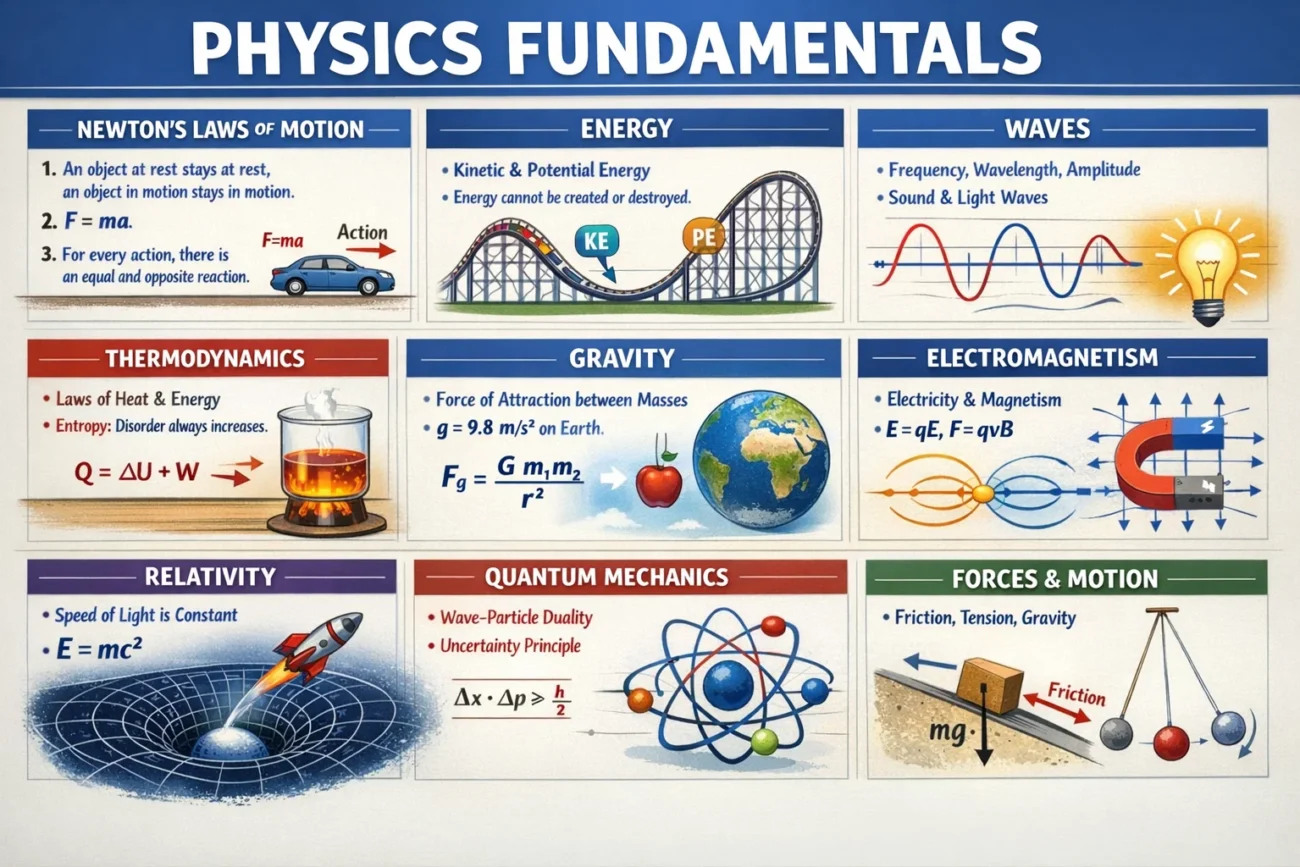
One of the most influential contributions to physics fundamentals came from Isaac Newton, whose laws of motion revolutionized our understanding of physical systems. Newton’s first law states that an object will remain at rest or move at a constant velocity unless acted upon by an external force. This principle introduces the concept of inertia, which is the tendency of objects to resist changes in motion.
Newton’s second law relates force, mass, and acceleration: the net force acting on an object equals its mass times its acceleration. This relationship allows scientists to calculate how much force is needed to move objects of different masses. Newton’s third law states that for every action, there is an equal and opposite reaction.
Energy Concepts in Physics Fundamentals
Energy is another essential component of physics fundamentals. Energy is defined as the ability to do work or cause change. It exists in many forms, including kinetic energy, potential energy, thermal energy, electrical energy, and chemical energy. Kinetic energy is associated with motion, while potential energy is stored energy based on an object’s position or condition.
Physics fundamentals teach that energy cannot be created or destroyed but can be transformed from one form to another. This principle is known as the law of conservation of energy. For example, when a roller coaster climbs to the top of a hill, it stores potential energy. As it descends, that potential energy converts into kinetic energy, causing the coaster to move rapidly along the track.
Work and Power in Physics Fundamentals
In the context of physics fundamentals, work and power are closely related to energy. Work occurs when a force causes an object to move in the direction of that force. For example, pushing a box across the floor involves applying a force over a distance, which results in work being done. Power, on the other hand, measures how quickly work is performed.
It represents the rate at which energy is transferred or used. These concepts are important in engineering and technology because they help determine the efficiency and performance of machines. By understanding work and power, engineers can design engines, motors, and electrical systems that operate efficiently while minimizing energy loss.
The Importance of Waves in Physics Fundamentals
Waves are another key topic within physics fundamentals. Waves transfer energy without transferring matter. Examples include sound waves, water waves, and light waves. Sound waves travel through the air as vibrations, allowing us to hear music and speech. Light waves allow us to see objects and experience colors.
Fundamental physics concepts explain wave properties such as wavelength, frequency, amplitude, and speed. These properties determine how waves behave and interact with different materials. Understanding waves has led to major technological advancements, including radio communication, medical imaging, and fiber-optic internet systems.
Electricity and Magnetism in Physics Fundamentals
Electricity and magnetism are closely connected topics that form a major part of physics fundamentals. Electricity involves the movement of charged particles, usually electrons, through materials. Magnetism arises from moving charges and magnetic fields. Together, these phenomena are known as electromagnetism.
Physics fundamentals explain how electric currents produce magnetic fields and how changing magnetic fields can generate electric currents. This relationship forms the basis of many technologies, including electric motors, generators, transformers, and communication devices. Modern society depends heavily on these principles, which power homes, industries, and transportation systems.
The Role of Thermodynamics in Physics Fundamentals
Thermodynamics is the study of heat, temperature, and energy transfer, and it plays an important role in physics fundamentals. The laws of thermodynamics describe how energy moves between systems and how it affects physical processes. For example, the first law of thermodynamics states that energy cannot be created or destroyed, only transformed.
The second law explains that energy transfers tend to increase disorder, or entropy, in a system. These laws help scientists understand processes such as engine operation, refrigeration, climate systems, and chemical reactions. By applying physics from thermodynamics, engineers can design more efficient energy systems and reduce energy waste.
Quantum Concepts and Modern Physics Fundamentals
As scientific knowledge expanded, researchers discovered that classical theories could not explain certain microscopic phenomena. This led to the development of quantum mechanics, an advanced area still rooted in physics fundamentals. Quantum physics describes how particles behave at extremely small scales, such as atoms and subatomic particles.
Unlike classical physics, quantum mechanics reveals that particles can behave like both waves and particles simultaneously. Physics in this field includes concepts such as energy quantization, wave functions, and uncertainty principles. These ideas may seem complex, but they are essential for understanding modern technologies such as semiconductors, lasers, and quantum computing.
Applications of Physics Fundamentals in Everyday Life
Although physics often seems theoretical, its fundamentals influence nearly every aspect of daily life. When you drive a car, Newton’s laws determine how the vehicle accelerates and stops. When you use a smartphone, electromagnetic principles allow signals to travel across networks. Even simple household appliances rely on basic physics concepts.
Refrigerators use thermodynamic principles to keep food cold, while microwaves rely on electromagnetic waves to heat food quickly. By understanding physics, people can better appreciate the technology that surrounds them and the scientific principles that make modern life possible.
Physics Fundamentals in Engineering and Technology
Engineering is built directly upon physics fundamentals. Engineers apply physical laws to design structures, machines, electronics, and transportation systems. Civil engineers use physics to calculate forces on bridges and buildings, ensuring they remain stable and safe. Mechanical engineers apply motion and energy principles to design engines, turbines, and robotics.
Electrical engineers rely on electromagnetism to create circuits, communication networks, and power systems. Without physics fundamentals, technological development would not have advanced to its current level. Every modern innovation, from satellites to renewable energy systems, relies on the fundamental laws of physics.
The Importance of Learning Physics Fundamentals
Learning physics fundamentals provides students with critical problem-solving skills and scientific understanding. Physics encourages logical thinking, mathematical reasoning, and experimental investigation. By studying physics, students learn how to analyze real-world problems and apply scientific principles to find solutions.
These skills are valuable not only in science and engineering but also in fields such as economics, medicine, and computer science. Physics education also promotes curiosity about the universe, encouraging students to explore questions about space, matter, energy, and the nature of reality itself.
Experimental Methods in Physics Fundamentals
Experiments play a vital role in validating and expanding physics fundamentals. Scientists perform experiments to test theories, measure physical quantities, and observe natural phenomena. Careful observation and measurement allow researchers to confirm whether theoretical predictions match real-world results.
For example, experiments involving pendulums help demonstrate the effects of gravity and motion. Laboratory studies of electrical circuits confirm the relationships between voltage, current, and resistance. Through experimentation, physics continues to evolve and improve as scientists discover new information about the universe.
Physics Fundamentals and the Future of Science
The study of physics fundamentals continues to shape the future of science and technology. Researchers are exploring new areas such as dark matter, gravitational waves, and advanced quantum technologies. These discoveries rely on the same basic principles that form the foundation of physics education.
As scientific knowledge expands, physics remain esse remainsr interpreting new observations and developing innovative technologies. Future advancements in energy production, space exploration, artificial intelligence, and medical technology will all depend on a strong understanding of these fundamental principles.
Conclusion
Physics fundamentals provide the essential framework for understanding the physical universe. They explain how objects move, how forces interact, how energy transforms, and how natural laws govern the behavior of matter and radiation. From Newton’s laws and energy conservation to electromagnetism and quantum mechanics, physics connects countless scientific ideas into a coherent system.
These principles influence everyday life, support modern technology, and drive scientific discovery. By studying physics fundamentals, we gain deeper insight into the workings of nature and develop the knowledge needed to innovate and solve complex global challenges.
You May Also Read: Brooklyn Nets vs Boston Celtics match player stats
